C/2025 D1 Groeller
more info
Comet C/2025 D1 was discovered on 20 February 2025 by Kitt Peak-Bok, that is more than three years before its perihelion passage. Soon, the prediscovery images of this comet were found going back to June 2018.
Comet had a perihelion distance well beyond the orbit of Saturn (14.1 au) and will pass the perihelion in May 2028; the closest approach to the Earth will be on 3 February 2028 (13.14 au), that is about 2.5 months before its perihelion passage.
GR solution given here is based on pre-perihelion data span over 6.72 yr in a range of heliocentric distances from 21.31 au to 15.11 au.
This is an Oort spike comet.
Comet had a perihelion distance well beyond the orbit of Saturn (14.1 au) and will pass the perihelion in May 2028; the closest approach to the Earth will be on 3 February 2028 (13.14 au), that is about 2.5 months before its perihelion passage.
GR solution given here is based on pre-perihelion data span over 6.72 yr in a range of heliocentric distances from 21.31 au to 15.11 au.
This is an Oort spike comet.
| solution description | ||
|---|---|---|
| number of observations | 34 | |
| data interval | 2018 06 06 – 2025 02 22 | |
| data type | perihelion within the observation arc (FULL) | |
| data arc selection | entire data set (STD) | |
| range of heliocentric distances | 21.31 au – 15.11au | |
| detectability of NG effects in the comet's motion | comet with determinable NG~orbit | |
| type of model of motion | GR - gravitational orbit | |
| data weighting | YES | |
| number of residuals | 65 | |
| RMS [arcseconds] | 0.32 | |
| orbit quality class | 1a+ | |
| next orbit statistics, both Galactic and stellar perturbations were taken into account | ||
|---|---|---|
| no. of returning VCs in the swarm | 5 | |
| no. of escaping VCs in the swarm | 4996 | |
| no. of hyperbolas among escaping VCs in the swarm | 2993 | * |
| next reciprocal semi-major axis [10-6 au-1] | -7.99 – -1.35 – 5.36 | |
| next perihelion distance [au] | 117 – 125 – 134 | |
| next aphelion distance [103 au] | 260 – 650 – 3600 | |
| synchronous stop epoch [Myr] | 2.45 | S |
| percentage of VCs with qnext > 20 | 100 | |
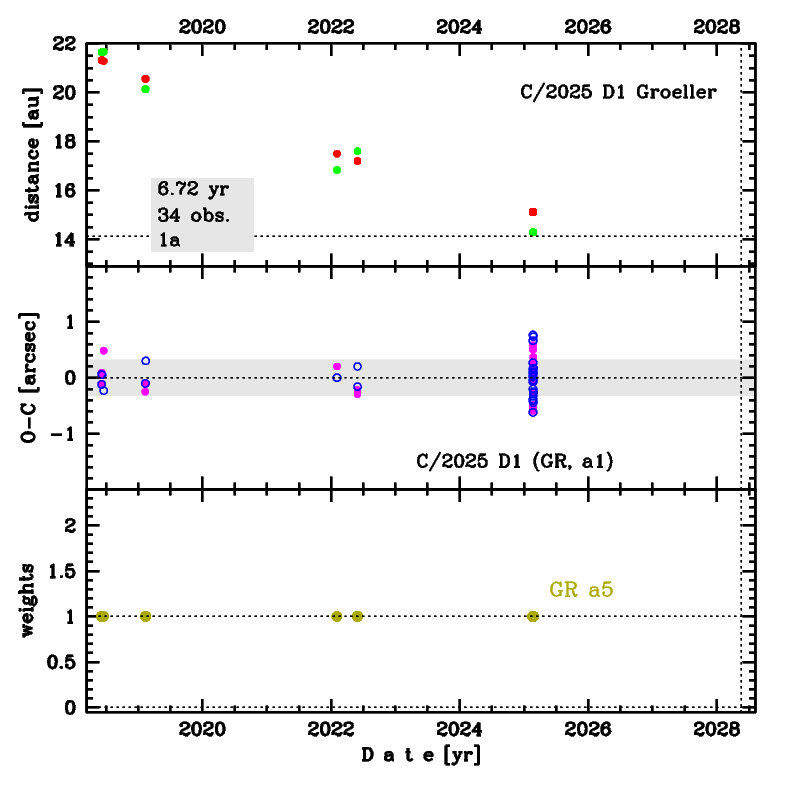
Time distribution of positional observations with corresponding heliocentric (red curve) and geocentric (green curve) distance at which they were taken. The horizontal dotted line shows the perihelion distance for a given comet whereas vertical dotted line — the moment of perihelion passage.
| next_g orbit statistics, here only the Galactic tide has been included | ||
|---|---|---|
| no. of returning VCs in the swarm | 6 | |
| no. of escaping VCs in the swarm | 4995 | |
| no. of hyperbolas among escaping VCs in the swarm | 2634 | * |
| next reciprocal semi-major axis [10-6 au-1] | -6.94 – -0.39 – 6.23 | |
| next perihelion distance [au] | 34 – 38 – 42 | |
| next aphelion distance [103 au] | 250 – 600 – 3400 | |
| synchronous stop epoch [Myr] | 2.51 | S |
| percentage of VCs with qnext > 20 | 100 | |